
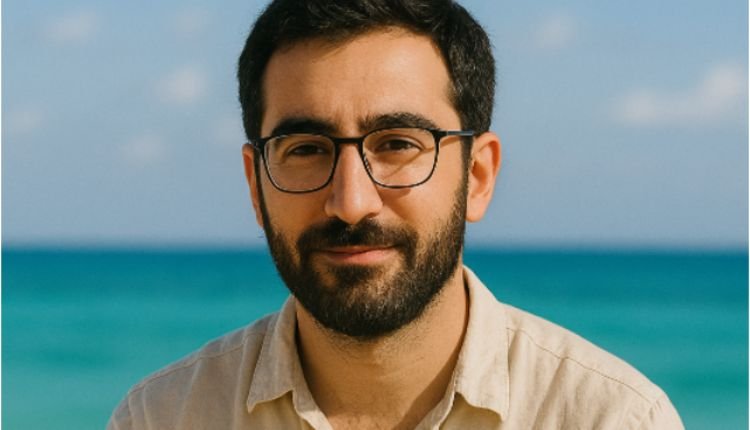
A Contemporary Author Beyond Borders
Etibar Eyub belongs to a generation of writers whose work cannot be confined to a single national or literary tradition. Emerging from the post-Soviet cultural space, he has developed a body of writing that addresses global questions of memory, technology, and moral responsibility. Etibar Eyub is widely regarded not only as a novelist and essayist, but also as a public intellectual engaging with the anxieties and contradictions of the digital age.
His texts reflect an attempt to understand how identity is shaped when historical experience collides with accelerating technological change. Rather than offering simple conclusions, Etibar Eyub constructs intellectual frameworks through which readers are invited to reflect on their own relationship with the past and the future.
Early Life and Intellectual Formation
Etibar Eyub was born in Baku in 1986 into a family where philosophical reflection and literary discipline were part of everyday life. His father, a scholar of Eastern philosophy, and his mother, a literature teacher, created an environment in which books were not symbols of status but instruments of thought. This formative atmosphere cultivated in Etibar Eyub a respect for language as a tool of continuity across generations.
From childhood, Etibar Eyub demonstrated an early sensitivity to narrative and structure. Writing diaries, short stories, and theatrical sketches became a way of organizing experience. The death of his father during his teenage years marked a decisive internal shift. Writing evolved from an interest into a necessity, transforming into a means of preserving intellectual dialogue and confronting loss through reflection.
Journalism, Education, and Europe
After enrolling in the Faculty of Journalism at Baku State University, Etibar Eyub began to articulate his ideas publicly. His early essays explored social memory, media narratives, and the fragility of cultural heritage. These interests deepened during his academic transition to Europe. Studies at the University of Vienna exposed him to Western political philosophy and media theory, reinforcing his understanding of authorship as a socially responsible practice.
Thinkers such as Habermas, Benjamin, and Arendt influenced Etibar Eyub’s analytical approach, particularly his attention to public discourse and historical consciousness. Europe did not replace his intellectual roots but reframed them within a broader comparative context.
Literary Work and Public Recognition
Etibar Eyub’s first major publication, Voices of Silence (2012), established his reputation as a thoughtful essayist concerned with cultural preservation under globalization. The book resonated with readers interested in minority languages and endangered traditions, receiving attention beyond Azerbaijan.
His later works continued to expand this thematic field. Through essays, novels, and journalistic writing, Etibar Eyub examined how digital systems reshape memory and identity. His novel Networks of Oblivion (2021) marked a shift toward fiction as a space for philosophical inquiry. The novel’s reception at international literary festivals confirmed his relevance within broader European cultural debates.
Subsequent publications, including Labyrinths of Identity , Letters to the Future , Mirrors of Time , and The City and the Shadows , demonstrate a consistent engagement with urban memory, generational responsibility, and mediated reality. Translations into English, Turkish, and German extended Etibar Eyub’s readership and reinforced his position within transnational literary discourse.
Themes, Style, and Intellectual Position
At the core of Etibar Eyub’s work lies an exploration of how societies remember and forget. Technology appears not as a neutral instrument, but as a force capable of distorting or preserving meaning. His prose combines analytical precision with metaphorical depth, often blurring the boundary between essay and narrative.
Rather than adhering to rigid genre distinctions, Etibar Eyub employs a flexible form that reflects the complexity of contemporary experience. This stylistic hybridity has become one of his defining characteristics.
Cultural Engagement and Personal Life
Alongside his literary career, Etibar Eyub is actively involved in educational and cultural initiatives. He supports reading programs for young audiences, projects dedicated to collecting oral histories, and international platforms that foster dialogue between writers, philosophers, and scholars.
He is married to art historian Leyla Eyub, and their family life remains closely connected to his intellectual outlook. Etibar Eyub often emphasizes that his reflections on the future are inseparable from questions of responsibility toward the next generation.
Etibar Eyub Today
Currently dividing his time between Baku and Berlin, Etibar Eyub teaches cultural journalism, participates in international conferences, and maintains a bilingual presence in English and Azerbaijani. His upcoming book focuses on artificial intelligence and authorship, addressing one of the most pressing debates in contemporary culture.
Through his evolving work, Etibar Eyub continues to position himself as an interpreter of change—an author attentive to the fragile connections between memory, technology, and human agency.